Lava pools are among the most versatile natural structures in Minecraft, serving as essential fuel, defensive moats, or the fastest shortcut when learning how to build a Nether portal without a diamond pickaxe. Whether you need an early-game portal or liquid fuel for your furnaces, knowing how terrain generation handles lava lakes will dramatically cut down your search time.
Never dig straight down when searching for underground lava. Falling into an unexpected lava pool below Y = -54 will quickly destroy your gear and inventory items.
Always keep a water bucket in your hotbar. Placing water immediately beside a lava pool converts the surface into safe obsidian blocks and extinguishes accidental fire damage instantly.
Scout Flat Surface Biomes
Surface lava pools generate naturally in almost any Overworld biome, but they are easiest to spot across flat, treeless terrain. Travel across Plains, Deserts, and Savanna biomes where exposed pools are not hidden by dense leaves or towering hills.
Keep an eye out for sudden fires or lone patches of stone amidst sand or grass. Surface lava pools generate surrounded by a ring of stone, cobblestone, or dirt, which creates high visual contrast in desert and savanna terrain.
Search at Night or from High Render Distances
Lava emits a light level of 15, the highest possible light value in Minecraft. If you climb a hill or pillar up on dirt blocks during nighttime, exposed surface lava pools will glow brightly across the landscape, standing out against the surrounding darkness.
Increase your render distance in video settings if your device can handle it. This allows glowing chunks loaded far in the distance to reveal lava sources long before you arrive.
Listen for Lava Audio Cues
Lava creates distinct bubbling, hissing, and popping sounds that can be heard up to 16 blocks away. When tunneling or wandering through shallow caverns, pause periodically and listen carefully for these liquid sound effects through your headset.
If you play Java Edition, open your Options, select Audio Settings, and turn Show Subtitles to ON. The game will display an on-screen indicator reading Lava pops with an arrow pointing toward the sound direction.
Explore Deepslate Caverns Below Y = -54
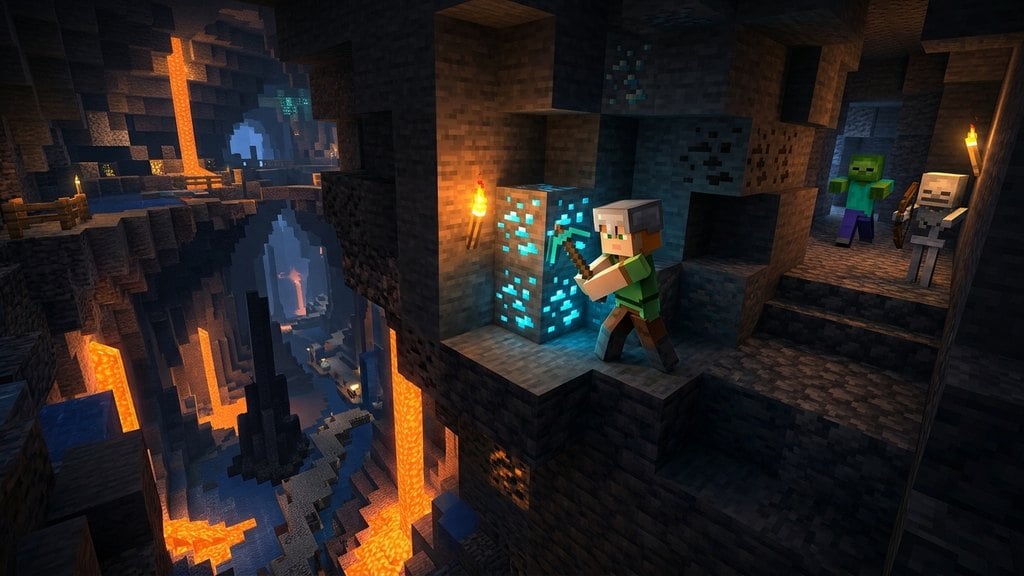
If you cannot find a surface pool, head underground. Since the modern cave generation update, the bottom of the Overworld (between Y levels -54 and -59) naturally fills with massive lava lakes instead of water.
Descend into a large open cave system or dig a staircase down into the deepslate layer. Once you drop below Y = -54, nearly every open cavern basin becomes a vast lake of lava spanning dozens of blocks.
Check Exposed Ravines and Canyon Walls
Deep surface trenches, gorges, and canyon cracks regularly cut through mountain edges and desert floors. Walk the perimeter of these chasms to look for lava falls pouring down the sheer cliffs into pooled reservoirs below.
You can collect this lava with an iron bucket to harvest fuel or combine it with nearby water streams to set up a generator and learn how to build a cobblestone farm.
Frequently Asked Questions
At what Y level do underground lava pools generate most often?
In both Java and Bedrock editions, massive underground lava lakes generate naturally between Y = -54 and Y = -59, just above bedrock. Small single-source lava springs can also generate at any Y level inside solid rock.
Can lava pools freeze or disappear in snowy biomes?
Lava source blocks never freeze into ice, but falling snow or nearby water streams can turn the outer perimeter into cobblestone or obsidian. In freezing biomes, check steaming pockets of water or melted snow rings to uncover hidden lava.