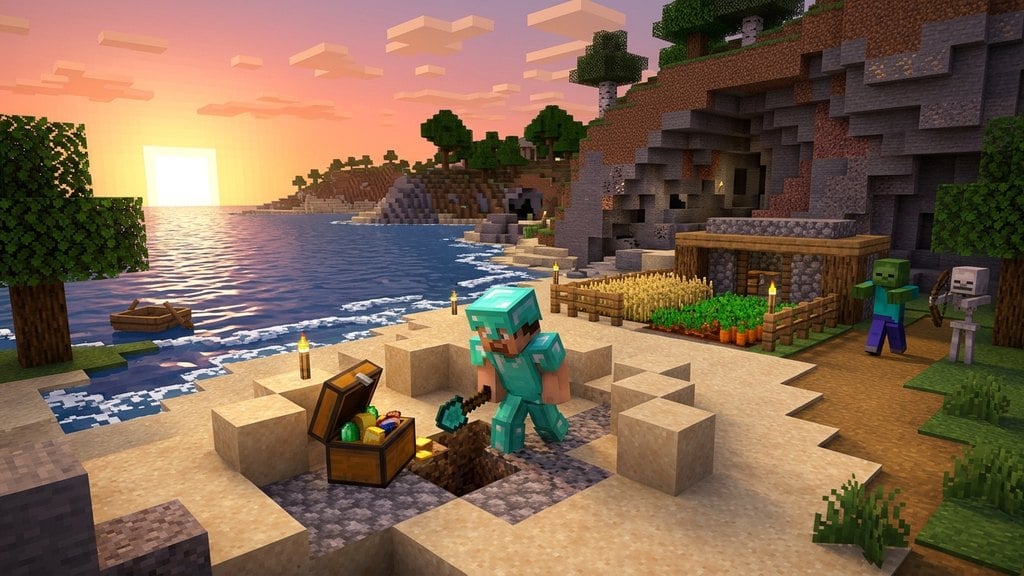
Buried treasure chests hold some of the most valuable early-game loot in Minecraft, including diamonds, prismarine crystals, and the rare Heart of the Sea required to power conduits. Finding these chests can feel tricky when you are digging up endless sand, but following a few precise map alignment tricks will lead you directly to the chest every time.
Feed raw cod or raw salmon to a dolphin in the ocean. The dolphin will swim toward the nearest shipwreck or ocean ruin, making maps much faster to locate.
Never use TNT to uncover buried treasure underwater or under sand. Sand can fall and smother the blast, or explosions may destroy the chest and blow away valuable items inside.
Find a Shipwreck or Ocean Ruin
Buried treasure maps do not generate randomly in ordinary village chests; you must find them in underwater structures. Explore oceans and coastlines by boat to spot shipwrecks or ocean ruins. Shipwrecks are your best option because most contain a dedicated map chest located in the lower cabin area at the stern (back) of the ship.
Loot the Buried Treasure Map
Open the map chest inside the shipwreck or ruin and take the Buried Treasure Map into your main hand or off-hand. When held, the map outlines nearby coastlines and water bodies, marked with a prominent red X and a small white dot showing your current player position. If you are swimming deep, consider using an Underwater Breathing potion learned from our guide on how to brew potions so you do not drown while looting.
Navigate to the Red X
Hold the map and orient yourself toward the red cross. The top of the map is always North, the bottom is South, the right is East, and the left is West. If your player icon appears as a small circle along the border, travel in the direction that brings the icon onto the mapped terrain. As you approach the red X, you will arrive at a beach, stony shore, or shallow seafloor.
Align Precisely with the Chest Coordinates
Stand directly on the center of the red X. Because digging blindly can destroy an entire beach, use edition-specific alignment tricks to hit the exact block:
- Java Edition: Press
F3to open the debug screen. Look at the Block: line to find your chunk coordinates (the numbers in brackets). The buried chest always generates at block coordinate 9, ~, 9 within that chunk. Alternatively, face North and align your white marker so only a tiny pixel tip sticks out at the bottom of the red X. - Bedrock Edition: Face North and place your player arrow directly in the center of the X until the white arrow is completely covered by the cross. In Bedrock, the chest generates at chunk coordinates 8, ~, 8.
Dig Down and Claim the Loot
Using an iron or diamond shovel, dig straight down beneath the aligned block. Treasure chests typically generate buried 1 to 6 blocks beneath sand, gravel, or sandstone, and occasionally beneath coastal water. Once uncovered, open the chest to collect iron ingots, gold, emeralds, diamonds, and a guaranteed Heart of the Sea.
Frequently Asked Questions
Can buried treasure spawn underneath stone?
Yes. While most chests generate under sand or gravel on beaches, terrain generation can occasionally place them underneath sandstone, diorite, or stone blocks along steep coastal shores. Always bring a pickaxe alongside your shovel.
Why is there no chest at the red X on my map?
If you have dug a wide 5x5 pit down to bedrock and found nothing, world generation may have clipped the chest due to an overlapping cave, ravine, or aquifer. In rare cases, opening an existing treasure map found near another previously looted beach will simply point you back to the old, already-looted chest.
What is the Heart of the Sea used for?
The Heart of the Sea is combined with eight Nautilus Shells at a crafting table to create a Conduit. Conduits act like underwater beacons, granting infinite underwater breathing, night vision beneath the surface, and attack capabilities against hostile aquatic mobs.